Was Luke in error about the date of Jesus’ birth?
 Before Christmas 2013 I watched the filmGravity. The effects were spectacular, the photography scenic, the characterisations engaging, and the story held ane'southward attention throughout. It even raised some profound (religious?) questions about life, death and purpose. And yet, when I left the cinema, I could not decide whether I had enjoyed the film or not. For some reason, I felt detached and rather distracted from it, but I wasn't certain why. Then I read the comments of some astronauts on how realistic a portrayal it was of life in space—and I realised what was distracting me. As great a story as information technology was, was it apparent? In that location were a number of things about it which kept nagging at me as implausible, and this distracted from engaging with the story. (If y'all desire to know, they were to do with whether unlike satellites were in synchronous orbit, whether y'all tin can see something conspicuously from a hundred miles away, and whether yous could go there just by pointing and shooting.) The following year I went to seeInterstellar and was not bothered in the aforementioned way—the film has been commended for getting the scientific discipline right.
I think this is how a lot of people feel most the Christmas stories. They might be profound, they might exist of great cultural significance, they might even signal to religious truth—only are they actually plausible?
Perhaps the greatest culprit in raising this question is Luke's comment about the timing of Jesus' birth. He appears to claim that Jesus was born in Bethlehem considering Joseph had to travel there to take office in the census, which was taken during the time when Quirinius was governor of the Roman province of Syrian arab republic, since this was his ancestral home.
In those days Caesar Augustus issued a decree that a census should be taken of the entire Roman world. (This was the first demography that took place while Quirinius was governor of Syria.) And everyone went to their ain town to register.
So Joseph also went upwardly from the town of Nazareth in Galilee to Judea, to Bethlehem the boondocks of David, considering he belonged to the house and line of David. He went at that place to register with Mary, who was pledged to be married to him and was expecting a child. (Luke 2.1–5)
At that place are a considerable number of meaning objections to this account; in scholarship in that location has been a long fence about this, and Howard Marshall (in his NIGTC commentary on Luke, p 99) decides that it is 'inconclusive'. The objections are as follows:
1. When Augustus issued this caste, Judea was not office of the Roman province, but was a client kingdom ruled by Herod the Bang-up. It would therefore non accept been part of any Roman demography.
ii. Quirinius was governor of Syrian arab republic from 6 to 12 Advertising, and not during the reign of Herod, who died in 4 BC, where both Luke and Matthew date the nascence. The governor of Syria then was either C. Sentius Saturninus (nine–6 BC) or perchance Quinctilius Varus (vi–4 BC).
three. There is no record of Romans requiring people to return to their ancestral home; people were registered where they lived, not where their ancestors came from.
4. In that location would have been no need to take Mary with him; registration was past the male caput of the firm but.
This has led some sceptical commentators to conclude that Luke is flatly contradicting Matthew, and demonstrates that neither record is historically reliable.
There is no way to rescue the Gospels of Matthew and Luke from contradicting each other on this one signal of historical fact. The contradiction is evidently and irrefutable, and stands as proof of the fallibility of the Bible, besides every bit the falsehood of at least one of the two New Testament accounts of the birth of Jesus.
But there are some things to sayimmediately in response to this. First, Luke is not contradicting Matthew; they both concord that Jesus was built-in during the reign of Herod the Great. In fact, because that they tell very dissimilar stories, presumably drawing from very different sources (Matthew'southward account focusses on the men, Luke'due south on the women), the number of points of factual understanding are quite remarkable.
Jesus was born in Bethlehem Matt ii:1 Luke 2:ii
In time of Herod (d. 4 BC) Matt ii:1 Luke ane:5
Mother: Mary Matt 1:18 Luke 1:26
Father: Joseph (named the child) Matt i:eighteen Luke 1:26
But not the biological father Matt 1:xvi, xx, 22 Luke 1:34; 3:23
Brought up in Nazareth in Galilee Matt 2:22-23 Luke 2:39
From the line of David Matt 1:1 Luke ane:32
Secondly, as Marshall p 102 points out, women were quite ofttimes involved in taking of the demography. He as well comments that 'it must exist presumed that Joseph had some holding in Bethlehem.' In fact, Stephen Carlson has argued that Bethlehem was Joseph's family home, non only his ancestral dwelling, and that he had come up to Nazareth to be betrothed to Mary, and was bringing her back to the (initial) marital habitation in Bethlehem. Interestingly, this thought concurs exactly with Matthew's business relationship, which only mentions Bethlehem, and makes no mention of the journey to and from Nazareth.
Thirdly, information technology is perfectly possible that Herod ordered a local census to exist taken, or that the Romans decided to intervene directly into matters of revenue enhancement. Information technology has been argued that if this were the case, Josephus would surely have mentioned information technology, but this is an argument from silence. We simply exercise not accept a complete historical record for the period.
Simply the significant problem remaining is that of the date of the census and the apparent impossibility of reconciling Herod'south reign and the flow that Quirinius was governor of Syrian arab republic. Josephus tells u.s.a. (inAntiquities 17.355 & eighteen.1–2) that Quirinius took a census of Syria and Judea in 6/7 Advert, in part every bit a manner of consolidating Roman rule over Judea later Herod the Great'due south son Archelaus was deposed and exiled. (Josephus argues that this led to the germination of the Zealot party, and was the incipient crusade of the Jewish War lx years subsequently; taxation is a way of confirming the subjugation of a nation to its purple rulers, hence the ability of the question in Matt 22.17.) Luke appears to refer to this as 'the' census in Acts 5.37.
At that place are two chief traditional arguments deployed in defence of Luke's accuracy.
 a. There are 3 inscriptions which are ofttimes cited every bit suggesting that Quirinius was governor of Syrian arab republic for two distinct periods: the Lapis Tiburtinus; the Lapis Venetus; and the Antioch Stones. Yous can read a transcript of all 3 hither. William Ramsay was the start to put this interpretation on them in 1912, and y'all volition find them cited oftentimes on apologetics websites. Just I agree with the sceptical commentator who has collated them: they don't actually demonstrate any such thing. We know who the governors of Syria were at the fourth dimension, and there is no known machinery under Roman government by which Quirinius could really be described in these terms at the correct time.
b. Could Luke ii.ii be translated as 'this was the censusbefore Quirinius was governor…'? As Steve Walton helpfully highlights in the previous discussion of this issue, this is the position taken by Tom Wright inWho was Jesus? (pp 98-99):
In the Greek of the time, as the standard major Greek lexicons point out, the word protos came sometimes to be used to hateful 'before', when followed (as this is) by the genitive case. A proficient example is in John 1.xv, where John the Baptist says of Jesus "he was before me", with the Greek being again protos followed by the genitive of "me".[xviii] I propose, therefore, that really the most natural reading of the poetry is: "This demography took identify before the time when Quirinius was governor of Syrian arab republic."…
My gauge is that Luke knew a tradition in which Jesus was built-in during some sort of demography, and that Luke knew likewise as we exercise that information technology couldn't have been the i conducted nether Quirinius, because by then Jesus was nigh ten years former. That is why he wrote that the census was the one earlier that conducted past Quirinius.
(In the comments on that post there is likewise a fascinating give-and-take about the reliability of Luke compared with Josephus.)
Other commentators fence that the grammar does not really permit for this, and it would suggest that Luke assumed his readers knew about another census, for which nosotros have no other historical bear witness—which Wright concedes.
Just the debate does not end there. Nosotros need to recollect that the registration for a census, in the context of the first century, was a complex and protracted affair. Around the aforementioned fourth dimension as Jesus' nascence in 6 BC, a demography commenced in Gaul that took 40 years to consummate. We know from Augustus himself (Res Gestae two.eight) that a census took place around the Empire somewhere around x–nine BC, and that it was intended to repeat this every 14 years.
Information technology is also worth noting that in comparing Luke with Josephus, we are not comparing a 'religious' text with a 'historical' one. On the one hand, Josephus had a clear motivation in writing his works, an atoning for the artifact and reasonableness of his native Jewish people. On the other, Luke appears to have been careful to observe the conventions of historiography of his twenty-four hour period. (Ane of the oddest things about the atheist/sceptical arguments is the style that Josephus is taken as infallible.) In biblical scholarship over the last 200 years, Luke has ofttimes been criticised for being unhistorical—only for subsequent archaeology to confirm the accuracy of his record, in particular in relation to the names and titles of Roman officials.
• Information technology was idea Luke was in error in mentioning 'Lysanias tetrarch of Abilene' (Luke three.1) every bit in that location was no tape of such a person—until an inscription was establish near Damascus which speaks of "Freedman of Lysanias the tetrarch" dated to the correct period.
• In Acts xiv, Paul and Barnabas go to 'Iconium in Phrygia', for which there was no archaeological evidence—until a monument was found in 1910 by Ramsay which confirmed this was the case.
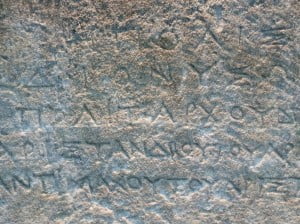 • In Acts 17, the leaders of Thessalonica are chosen 'politarchs'. It was thought that Luke had made this term upward, until information technology was confirmed in inscription—19 in all, one of which can be seen in the museum in the modern metropolis (my photo of information technology at left; you tin see the word POLITARXOU beyond the middle).
• Luke'due south references to 'proconsul Sergius Paulus' in Acts 13.7 and 'Gallio was proconsul of Achaia' in Acts xviii.12 were both thought to exist mistaken until confirmed past inscriptional evidence. The dating of the year in which Gallio was proconsul, 51/52, in fact now forms a major stock-still point in confirming the chronology of Paul'south life and writings.
(This is not to say that in that location are no bug near the historicity of Luke-Acts. But information technology is perhaps worth noting that all the above arguments confronting Luke'southward accuracy accept been arguments from silence, and that non a single of the discoveries has really proved Luke to be mistaken.)
On the other hand, nosotros know from his two major works that Josephus was capable of changing his data to support his arguments. John Rhoads notes, in a recent article:
When reporting Archelaus's symbolic dream, he reported that Archelaus saw 9 ears of corn representing 9 years of rule in J.W. 2.112–xiii but 10 ears of corn representing ten years of dominion in Ant. 17.345–47. So, in ane of these accounts, he changed the number of ears of corn and the number of years of dominion from how they appeared in his source in club to match his reconstruction of events. Then, indeed, it is quite possible that Josephus similarly changed the date for the census to match his reasonably reconstructed chronology of events.
As a consequence of this, and other analysis of Josephus' account, Rhoads argues that of the two historical accounts, Luke'due south is the more than authentic, and Josephus is mistaken. He suggests that Quirinius did initiate the census during the reign of Herod; the possibility and then arises that it was but completed when he had become governor (Legate) of Syria some years later.
Intriguingly, this ties in well with a quite separate argument about Luke's language here. Marshall notes that 'the form of the judgement is in whatsoever example odd' (p 104); why say something was 'first' when at that place is nix to compare information technology with? Stephen Carlson has looked even more closely, and also noted that the verbegeneto also seems strange; why suggest the census 'became' something, rather than that information technology only 'was'? Carlson suggests thatprote, rather than 'get-go' numerically, should be read as 'of well-nigh importance'—much as we might say 'and so-and-then is Armory's Number One player.' This would and so requite the translation as:
This registration became most prominent when Quirinius was governing Syria.
or
This [decree to get registered] became the/a most important registration when Quirinius was governing Syrian arab republic.
In the cease, the mystery of the conflict between Luke and Josephus remains unsolved and (as Marshall puts it) 'can hardly be solved without the discovery of fresh show.' But these arguments at least offer a plausible explanation—and when considering questions of history, proof is rarely possible, simply plausibility is an important measure. It certainly offers no grounds to write off Luke's account, call up it unhistorical or a fabrication, or meet it as in conflict with Matthew.
So, different my feel of watchingGravity, equally we read the nativity accounts we can put our anxieties to rest—and tin can savor and engage in the narrative as nosotros have information technology in Luke. And what is the point of mentioning Augustus, Quirinius and Herod—or for that matter Lysanias, Iconium, politarchs, Sergius Paulus, Gallio and all the others? Luke is making a very specific point—that this is non only a story nearly the Jews for the Jews, but in fact will touch and shake the whole globe, including its rulers. And because of that, you and I are reading the story today.
The solar day earlier posting this, I learnt that Howard Marshall had died following a very short battle with pancreatic cancer. Yous can read here a tribute to this fine scholar and Christian disciple.
Follow me on Twitter @psephizo.Similar my page on Facebook.
Much of my work is done on a freelance basis. If you have valued this mail service, would yous considerdonating £ane.twenty a month to back up the production of this weblog?
If you lot enjoyed this, do share it on social media (Facebook or Twitter) using the buttons on the left. Follow me on Twitter @psephizo. Like my page on Facebook.
Much of my piece of work is done on a freelance basis. If you have valued this postal service, yous tin can make a unmarried or echo donation through PayPal:
Comments policy: Proficient comments that appoint with the content of the postal service, and share in respectful contend, tin can add existent value. Seek first to empathise, then to be understood. Make the most charitable construal of the views of others and seek to acquire from their perspectives. Don't view debate every bit a disharmonize to win; address the argument rather than tackling the person.
Source: https://www.psephizo.com/biblical-studies/was-luke-in-error-about-the-date-of-jesus-birth/
0 Response to "Was Luke in error about the date of Jesus’ birth?"
Postar um comentário